Share this article
Put it on someone else's radar
Use the quick-share sheet, send it to social, or copy the link for a text or post.
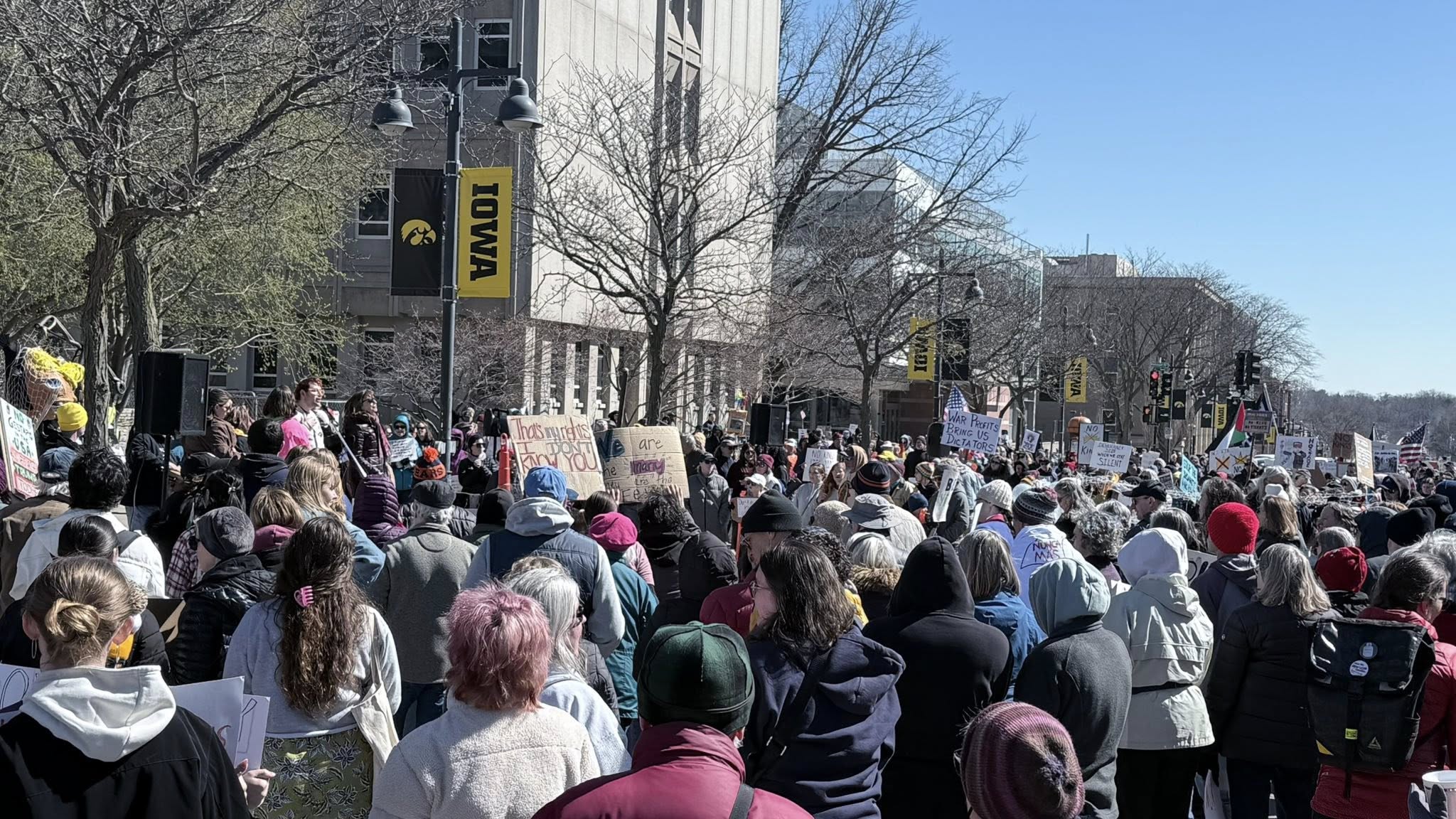
By late morning Saturday, Iowa Avenue and the Pentacrest had taken on the feeling of a gathering place rather than a flashpoint. The crowd, estimated by The Daily Iowan at about 1,000 people, filled the street and campus edge with handmade signs, winter jackets, conversation, and the slow movement of people finding one another in public. This was part of a much larger national day of No Kings demonstrations, with more than 3,100 events registered across the country, but in Iowa City the mood read first as local: neighbors downtown, students on foot, families with children, and community members choosing to be visibly present together.
What stood out most was the breadth of who showed up. Photo coverage from the event captured children holding signs above their heads, a veteran wearing pins on his hat, and a protester drumming while marching through downtown. There were speakers and organizers, of course, but also the quieter details that tend to define a city more than a slogan does: people pausing at the curb, looking around, listening, deciding to stay. In a town like Iowa City, where civic identity often lives somewhere between campus life, neighborhood life, and public debate, the crowd looked less like a single bloc than a cross-section.
The event itself was structured less like a burst of anger than a shared public ritual. The Daily Iowan reported that poster-making began at 9 a.m., with the program continuing through noon. Iowa City City Councilor Mazahir Salih spoke, as did Ninoska Campos of Escucha Mi Voz, alongside other organizers. Local groups set up stands, and the gathering included art installations that gave the event a visual language beyond chants and speeches. One installation depicted a symbolic ICE detention camp; another used the imagery of balance, weighing community values against a political figure. Whether viewed as protest art or civic theater, both suggested an effort to make public feeling visible in a form people could walk around, react to, and remember.
Then there was the march itself. The photographs show people moving down Washington and Dubuque streets in a way that felt familiar to anyone who has watched Iowa City turn out for causes, celebrations, or grief. Crowds here do not always look dramatic from a distance. Often they look like what they are: residents stepping into the street to register that they have seen something, felt something, and do not want to remain private about it. That may be why the event seemed to carry less of the spectacle associated with national protest imagery and more of the texture of local civic life.
In a polarized moment, it is easy to describe any rally only in terms of its loudest messages. But on the ground, the Iowa City event also appeared to be about recognition: seeing who else came, who brought their children, who carried a sign, who stood quietly at the edge, who marched anyway. Public life is not made only by elections, council votes, or formal meetings. Sometimes it is made by a cold morning downtown when people decide that showing up counts for something. On Saturday, that seemed to be the point as much as anything else. In Iowa City, the No Kings rally looked less like spectacle and more like civic turnout.