Share this article
Put it on someone else's radar
Use the quick-share sheet, send it to social, or copy the link for a text or post.
David Axelrod came to Hancher Auditorium on Tuesday night with a résumé full of big political history, but the most memorable parts of the evening were not campaign-war stories or insider analysis.
They were about friendship, health care, social media, and whether American public life can still hold together when people are trained to see disagreement as betrayal.
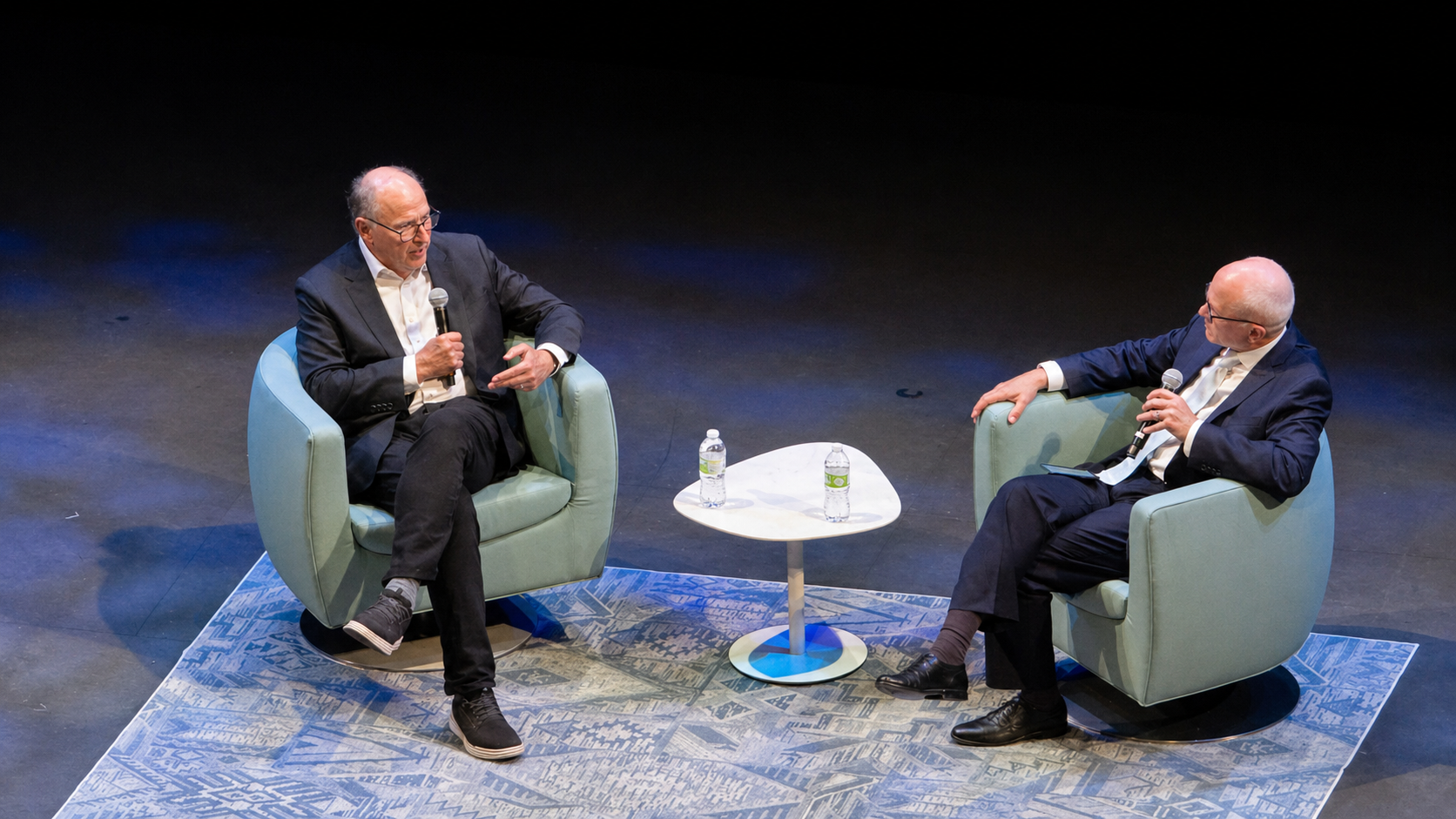
Axelrod, the longtime Democratic strategist best known as the architect of Barack Obama’s presidential campaigns, appeared April 28 as part of the University of Iowa College of Law’s Levitt Lecture Series. The conversation was moderated by Ben Kieffer, host of Iowa Public Radio’s River to River. Todd Pettys, dean of the College of Law, welcomed the audience.
The event had the shape of a formal university lecture, but it quickly became more conversational. Kieffer guided Axelrod through Obama, Trump, Congress, the media, the Affordable Care Act, redistricting, artificial intelligence, and Axelrod’s recent meeting with Pope Leo.
Again and again, though, Axelrod returned to one concern: the country is losing the ability to treat political opponents as human beings.
At one point, Axelrod talked about his friendship with a conservative commentator, Scott Jennings. The simple word “friend,” he said, can now draw a strange reaction.
“We’re not supposed to be friends,” Axelrod said, describing the mood of the country. “Just as our elected officials aren’t supposed to be friends if they have different points of view. And that is going to destroy us.”
That line landed as one of the evening’s clearest warnings. Axelrod was not arguing for bland agreement or pretending that the stakes are low. He was clear about his view of Trump and the danger he believes Trump poses to democratic norms. But he also seemed worried about something larger than one president or one election cycle.
He described a political and media environment where people increasingly live in different realities. Social media, he said, rewards conspiracy thinking because it keeps people engaged. In moments of crisis, one part of the country immediately blames the other side, while another part immediately assumes the event was staged.
“Conspiracy theories had popped from minute one,” Axelrod said. “Because they are what sells, and these algorithms are ruthlessly effective in spreading them.”
Asked to compare the Obama years with the present, Axelrod pushed back against any simple nostalgia. The country was already deeply divided when Obama ran in 2008, he said. But part of Obama’s appeal was the possibility that people could still work together across party lines.
He recalled that some of the campaign’s early ads in Iowa featured a Republican state senator from Illinois, Senator William “Bill” Brady, talking about what it was like to work with Obama.
“People found it refreshing to think that people could actually work together and respect each other even as they disagreed,” Axelrod said.
Kieffer pressed him on the future, including what kind of candidate voters might look for after the Trump era. Axelrod said presidential elections often work as a reaction to the person currently holding power. Voters, he said, rarely choose a replica of what they already have.
He believes the country may eventually look for something quieter and more grounded.
“They’re going to be looking for character,” Axelrod said. “They’re going to be looking for humility. They’re going to be looking for empathy. They’re going to be looking for honesty. They’re going to be looking for integrity.”
He compared that possible political mood to the period after Watergate, when voters turned to Jimmy Carter, a Sunday school teacher from Georgia, as a kind of national reset. Iowa, Axelrod noted, helped propel Carter forward.
Some of the sharpest exchanges came when Kieffer brought up Congress and the difference between the Nixon era and the present. Axelrod said members of Nixon’s own party eventually went to him and told him he could not survive impeachment. He questioned whether that same thing could happen now, in part because Trump continues to hold such power over Republican primaries.
He also wondered whether Nixon would have resigned in today’s media environment.
“Would Richard Nixon have resigned if he had Fox News, if he had social media?” Axelrod asked.
For Axelrod, the issue was not just partisan media. It was the collapse of a shared information environment. He pointed to the disappearance of older broadcast norms and the rise of systems that push people toward outrage, suspicion, and certainty.
The evening’s most personal moment came when Axelrod talked about the Affordable Care Act.
He told the audience about his daughter Lauren, who began having serious seizures as a child. His family had health insurance through his job at the Chicago Tribune, but he said he learned quickly that the coverage was “great if you were healthy and inadequate if you weren’t.”
Her medication became expensive. The family had trouble getting second opinions. And because she had a preexisting condition, other insurance was out of reach.
When Obama considered whether to pursue health care reform, Axelrod said his political advice was caution. Seven presidents had tried. Seven had failed. The fight could cost Obama his reelection.
Obama, according to Axelrod, understood the risk but decided the work mattered.
On the night the Affordable Care Act passed in 2010, Axelrod said he was in the White House with the president, vice president, and staff as the votes came in. Then he left the room, crossed the hall to his office, closed the door, and sat alone.
When he heard cheering from the other room, he began to cry.
“It’s an embarrassing admission for the hard-bitten political guy to be sobbing in the White House,” Axelrod said.
He said he was thinking about his daughter, his family, and the millions of families who would not have to go through what they had gone through. Later, he thanked Obama on behalf of those families.
Obama put a hand on his shoulder and told him, “That’s why we do the work.”
That story gave the evening its emotional center. Axelrod used it to make a broader point about politics. People get caught up in which team is winning, who is up, who is down, and what the next fight will be. But at its best, he said, politics is supposed to make someone’s life better.
The audience questions widened the discussion. One question asked about Axelrod’s recent meeting with Pope Leo, a visit that has drawn conspiracy theories online. Axelrod said the meeting had been requested months earlier through Chicago relationships and focused on social media, artificial intelligence, and the moral crisis he sees in public life.
He said the business model of social media works against the idea of shared humanity.
“The political crisis that we’re encountering here and elsewhere is moral in nature,” Axelrod said.
He declined to discuss the pope’s responses in detail but described him as “extraordinarily graceful, thoughtful, disarmingly humble, and very, very smart.”
Another question focused on redistricting and whether gerrymandered districts are pushing American politics further toward extremes. Axelrod said the country has fewer and fewer genuinely competitive districts, which makes primaries more important than general elections in many places.
That, he suggested, helps explain why many elected officials fear challenges from within their own party more than defeat by the other side.
The Levitt Lecture Series began in 1997 and is supported by the Levitt Family Lectureship Fund. According to the event program, Axelrod’s appearance was the 37th Levitt Lecture. Previous speakers have included Nobel Peace Prize recipients, a sitting U.S. Supreme Court justice, former U.S. attorneys general, Pulitzer Prize-winning journalists, and authors.
Axelrod did not offer the audience a clean answer to the country’s political condition. He kept circling back to something simpler and harder to measure: whether people can still disagree without treating each other as enemies.
For a law school lecture, that question felt especially pointed. Institutions matter. Rules matter. Elections matter. But Axelrod’s warning was that none of them can carry the weight alone if the people inside the system no longer believe restraint, character, and public responsibility are worth defending.