Share this article
Put it on someone else's radar
Use the quick-share sheet, send it to social, or copy the link for a text or post.
On Tuesday afternoon, College Green Park filled with a kind of public energy that can be easy to miss until you are standing in the middle of it. Music carried from the gazebo. Speakers took the mic. People moved between advocacy tables, paused for conversations, picked up information and stayed in the park long enough for the gathering to feel settled, social and grounded.
The occasion was Southeast Iowa Trans Day of Visibility 2026, a local event that brought together performers, organizers, advocates and community members for an afternoon built around visibility in the broadest sense of the word. There was music, art, resource sharing and a steady public presence. There was also something just as important: a feeling that people had come to be with one another, not simply to pass through.
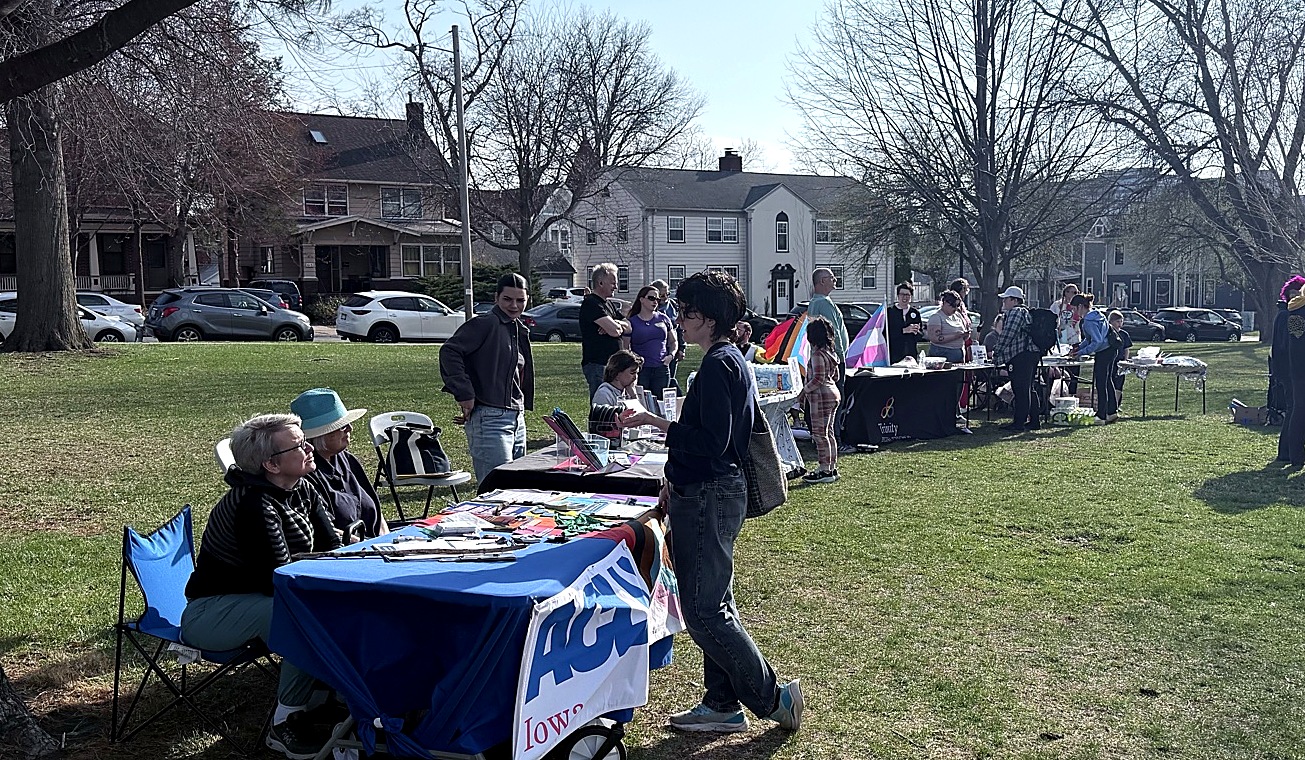
Performances by Allegra Hernandez, Early Girl and The Quire gave the event its rhythm. Around them, tables from local organizations and advocacy groups gave the afternoon its practical shape. The Johnson County Trans Advisory Committee, DVIP-RVAP, the ACLU of Iowa, United Action for Youth, the Iowa City Office of Human Rights and Corridor Community Action Network were among those listed as participants.
That combination mattered. Too often, public events get flattened into a single category: rally, celebration, protest, fair. What happened at College Green Park moved more fluidly than that. It carried the warmth of a community gathering, the seriousness of a civic event and the usefulness of a resource hub. People could listen to speakers, hear live music, talk with organizers, collect information and simply spend time in a space where support was out in the open.
What stood out most was how naturally the afternoon fit the park around it. People sat in folding chairs, drifted between tables and stopped to talk in small groups while volunteers kept things moving. The houses around the square, the handmade signs, the coolers on the grass and the easy back-and-forth between music and conversation gave the gathering a lived-in, neighborhood feel. Nothing about it seemed overworked. It felt like Iowa City showing up as itself.
That is often where the real value of a local event becomes clear. Not only in the official program, but in the way the day comes together through actual people doing actual work. Organizers set the tone. Performers draw people in. Advocacy groups offer information people can take home. Attendees listen, linger, ask questions and make the event feel shared rather than observed. That fuller picture is what gives an afternoon like this its weight.
The turnout looked solid, with people spread across the lawn, gathered near tables and clustered around the gazebo. Some came to listen. Some came to speak. Some came to perform. Others seemed to come for something quieter but equally important: being there, being seen and seeing others show up too.
Mandi Remington, founder and director of Corridor Community Action Network, was part of that organizing presence. People like that often shape an event long before the microphone turns on. They connect the groups, coordinate the logistics, invite participation and give the day enough structure to hold together without feeling overmanaged. That work rarely draws the most attention on site, but without it, the public-facing part never quite arrives.
What College Green Park held Tuesday afternoon was more than a symbolic observance. It was a clear example of local civic life in action: visible, imperfect, human and shared. In a time when many people feel pressure to shrink from public life, there was something meaningful about seeing a park filled instead with music, advocacy, conversation and a straightforward commitment to one another.
For Iowa City, that matters. For the people who attended, it likely mattered even more.